Performance Days
Performance Days13–14 October 2026
The Sustainability Exchange
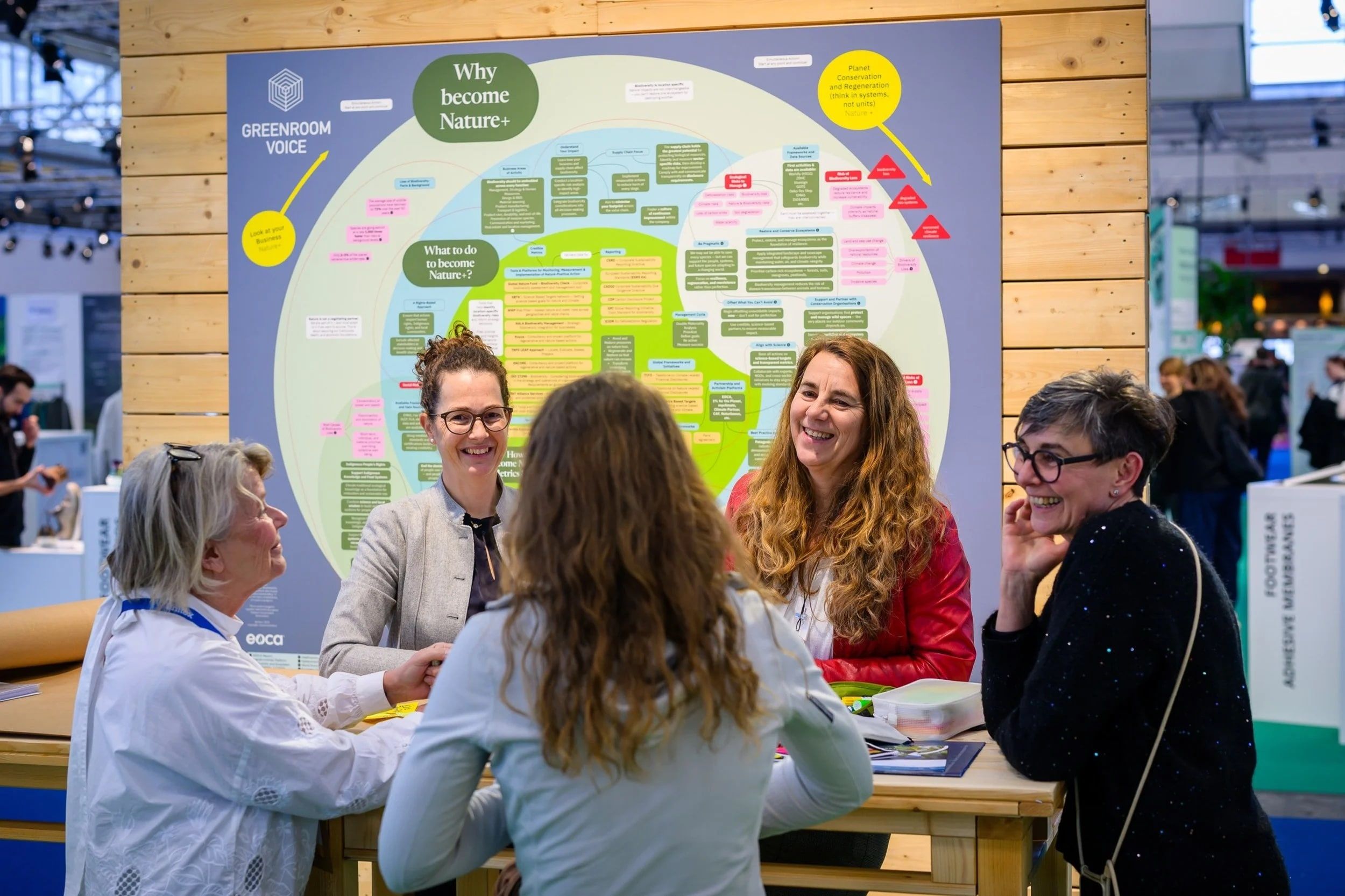
The GRV Collective Learning Series at Performance Days in Munich: three practical workshops at the Sustainability Workshop Table.
From more data to better shared data. The task now is to keep the dialogue going year-round.
- Three very different workshops, one common thread: the missing link is data that is reliable, shared and able to travel along the supply chain.
- Suppliers enter the same data into several platforms, verified claims are becoming a must under EmpCo, and nature risks stay invisible below Tier 4.
- The way forward: partnerships, common standards, and a stronger voice for the people who hold the data, from suppliers to farmers.
About · 01
An open yet intimate space
The Sustainability Exchange, formerly the Sustainability Lounge, came back to the October 2026 edition of Performance Days in an even more interactive format. Over two days, the GRV Collective Learning Series brought brands, suppliers and experts to the Sustainability Workshop Table to work on human rights due diligence, product certification and biodiversity risk.
Feedback from our partners was clear: guests naturally engaged in dialogue, sparked discussions and forged new connections. With its open yet intimate atmosphere, the space lays the groundwork for future collaborations.
Next edition: 17–18 March 2027, Messe München. We will continue the GRV Collective Learning Series in this space, with workshops on advanced sustainability topics.
Program · 02
Advance Together: GRV Collective Learning Series
13–14 October 2026, Sustainability Workshop Table, Hall A4.
Tools for supporting Human Rights Due Diligence: smarter social & labour data collection with SLCP.
Tuesday 13 October 2026, 11:00–11:45 CEST. This workshop will discuss the industry’s HRDD tool ecosystem and how companies can avoid over-burdening facilities with repetitive data requests. A session with practical examples; come and bring your questions and challenges.
How to turn sustainability ambitions into certified products? Green Shape as a practical solution.
Tuesday 13 October 2026, 14:00–14:45 CEST. Is your brand looking for an environmental standard and a third-party certification system for apparel and outdoor textile products, including EmpCo-compliant product labelling? Get to know the new Green Shape Standard, developed by VAUDE, now completely independent. Learn from best-practice examples; questions welcome.
Biodiversity loss as a business risk: how to identify and manage nature-related risks in textile supply chains.
Wednesday 14 October 2026, 11:00–11:45 CEST. The Global Nature Fund (GNF) workshop is taking place as part of the ‘Biodiversity Risks in the Upstream Supply Chain’ project, funded by the Funk Foundation, and provides an insight into initial findings on nature-related risks in textile supply chains.

Results · 03
The missing link is data
By GreenroomVoice, 28 October 2026.
The textile industry is not lacking in sustainability ambition. It lacks data that is reliable, shared and able to travel along the supply chain. That was the clear common thread of the three workshops held at the Sustainability Exchange of Performance Days Munich on 13 and 14 October 2026, organised by Anna Rodewald of GreenroomVoice.
The topics could hardly have been more different: human rights due diligence, environmental product certification and biodiversity at farm level. Yet in each session, brands, suppliers and producers ended up at the same point. Whether the goal was protecting workers, proving a product claim or managing nature-related risks, progress stalled where information stopped.
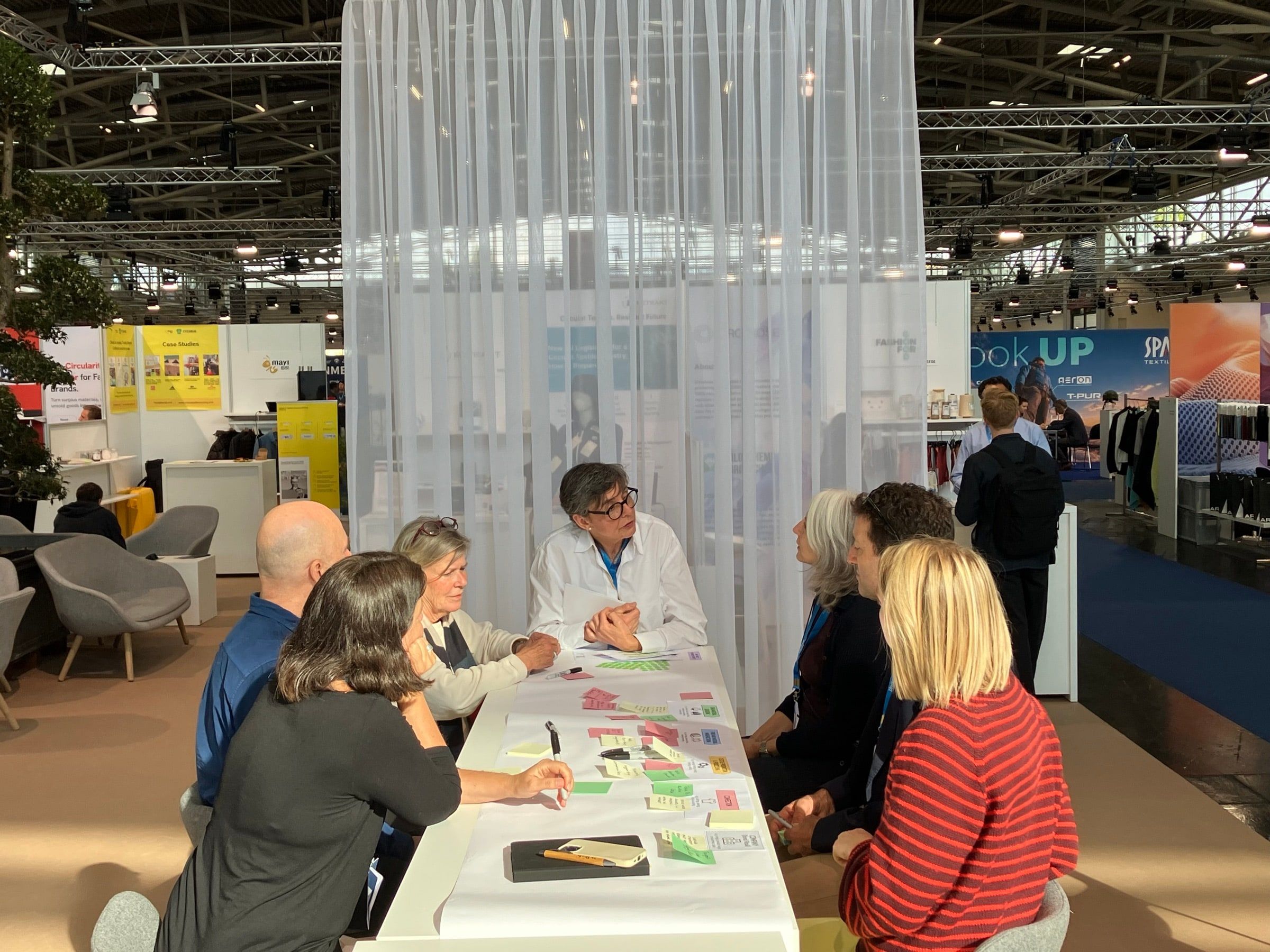
Progress stalled where information stopped.
Results · 05
Green Shape: turning data into a verifiable claim
Led by Hilke Patzwall, board member of the Green Shape Verein
If the SLCP session showed the cost of fragmented data, the Green Shape workshop showed what verified data can be worth.
Hilke Patzwall presented a standard that has just made an important step. Introduced by VAUDE in 2010 as an internal environmental label, Green Shape has been available since summer 2026 as a fully independent, certified industry standard, owned by the non-profit Green Shape Verein zur Förderung umweltfreundlicher Bekleidung und textiler Outdoor-Produkte e.V.
2010
Green Shape introduced by VAUDE as an internal environmental label
2026
an independent, certified industry standard, open to every textile brand
The timing is no coincidence. Under the EU Empowering Consumers for the Green Transition Directive (EmpCo), environmental claims must be substantiated. Brands that want to keep communicating their products’ sustainability need independent evidence, or they risk accusations of greenwashing. Patzwall argued that an independent standard sends a clear signal to retail and consumers that a claim has been externally verified rather than self-declared. It also creates a common benchmark across the industry and makes listing with retailers easier, as more of them demand robust proof. According to Patzwall, Green Shape is registered as an EU certification mark, the only one in this field besides the German government’s Grüner Knopf.
How it works
Certification works at the product level. Brands pay a licence fee to the Verein based on their turnover, while sampling scope is agreed with the certification body in an audit plan. Control Union currently carries out the audits.
The difference to Grüner Knopf lies in focus: Grüner Knopf centres on human rights and covers few environmental criteria, while Green Shape concentrates on ecological product criteria. Social and human rights issues are checked by the Verein as a “gate zero” before a brand can start working with the certification body. Requirements are also more product-specific: as with GOTS, only the product needs to be certified, not the entire brand.
VAUDE was the first to use the independent standard, with its winter collection 2026/27 certified by Control Union. During the 45-minute discussion, further outdoor and fashion brands showed interest. Patzwall emphasised that the standard is now open to every brand in the textile sector.
Results · 06
Nature-related risks: the blind spot at raw-material level
Led by Bettina Faust, Global Nature Fund (GNF)
The third workshop moved the question to the very beginning of the value chain. How does the textile industry depend on nature, and how does it affect it? And what do companies actually know about it?
The honest answer from participants: often very little. Many textile companies described tracing supply chains back to the raw-material level (Tier 4) as difficult. Without that traceability, a meaningful analysis of nature-related risks is hardly possible.
The most striking comments came from the producers themselves. A representative of an Australian sheep farm reported that biodiversity loss is clearly noticeable at farm level and that countermeasures have been in place for some time. Raddis Cotton described its regenerative approach, which focuses on improving soil health, biodiversity and water use while reducing synthetic inputs.
Valuable knowledge already exists at the source. It rarely reaches the brands further downstream.
The workshop raised a question that now feeds into GNF’s ongoing research: what information on origin, production sites and biodiversity measures do companies really have, and can it be used for risk analysis? Certifications such as GOTS help, but participants made an important distinction. A certificate verifies defined sustainability requirements. It does not automatically assess the site-specific nature risks a business is exposed to.
GNF stressed that these were qualitative observations from a small dialogue, and that further company interviews are needed.
Results · 07
From more data to better shared data
Taken together, the three workshops make a strong case: the industry needs more data, and above all data that can be trusted and shared. Social audits, product certificates and farm-level biodiversity measures all generate valuable information. Yet much of it remains locked in individual platforms, companies or tiers of the supply chain.
Regulation is accelerating the need to change this. Forced labour rules, due diligence obligations and the EmpCo directive all require companies to substantiate their claims. That proof depends on data that flows from farm to factory to brand.
Partnerships+Common standards=Data that travels
The workshops also pointed to the way forward. Data needs partnerships, common standards, and platforms that reduce duplication rather than add to it. And the people who hold the data, from suppliers to farmers, need a stronger voice in the conversation. The Sustainability Exchange at Performance Days gave them that voice for two days. The task now is to keep the dialogue going year-round.
Want to go deeper into one of the sessions? Write to us and tell us which one.
Performance Days, Munich, Hall A4
Results · 04
Social due diligence: data exists, but nobody can see it
Led by Lottie Watkinson, Social & Labor Convergence Program (SLCP)
The first workshop made the paradox explicit. SLCP is an NGO that conducts more than 10,000 social assessments across the textile supply chain every year. The session focused on two stages of the OECD due diligence approach: identifying and assessing risks, and tracking whether the measures taken actually work. Both stages depend entirely on good data.
10,000+
social assessments a year across the textile supply chain
2 stages
of OECD due diligence in focus: assessing risks, and tracking what works
The discussion quickly revealed how fragmented that data is. Participants described suppliers entering the same Tier 1 and Tier 2 information into several platforms, from Higg to ISO-based systems, because each customer asks for a different scheme. Brands push certification costs onto suppliers while still demanding every certificate. For Tier 2 facilities in particular, the investment is hard to justify, and no one can say when those costs would ever be recovered.
Even where data exists, its quality is not guaranteed. Participants pointed to grey zones in certification, including fake offices, that undermine trust in audit results. And transparency varies widely: ISO data remain closed, while data in SLCP or Higg can be shared. Accessing them requires partnerships, and with SLCP, manufacturing facilities keep ownership of their own data.
The pressure to close this gap is growing. EU rules currently apply mainly to large companies, but the regulation of forced labour marks the point at which human rights due diligence begins, and participants agreed that requirements will become stricter for everyone. Their advice to brands was pragmatic:
Secure management commitment.
Due diligence needs backing from the top.
Research your own supply chain in depth.
Know who is behind each tier before you ask them for data.
Start where you are.
Use the tools that already exist rather than waiting for a perfect one.
Collaborate across the chain.
In the spirit of SDG 17, and with the question of whether the outdoor industry could set an example.
Participants also had a clear message for future events: talk with suppliers, not just about them. Supply chain partners need a stronger voice on panels and a place at the table when NGO tools are developed.